Brita Small 6 Cup: The Small Tank and the Cartridge That Never Shrinks
The Brita Small 6 Cup is a 48 ounce jug sold with a cartridge rated for 40 gallons, and those two numbers do not age at the same speed. The Original filter, model OB03, sits on Brita's own performance data sheet with NSF/ANSI 42 and NSF/ANSI 53 and a percentage beside every substance in the table, and the sheet's system numbers include OB11, which is the body code on this listing. It holds rank 2 in Pitcher Water Filters as of our last check and ships from Amazon itself in the $25 to $30 band. Read the clock before you read the price.
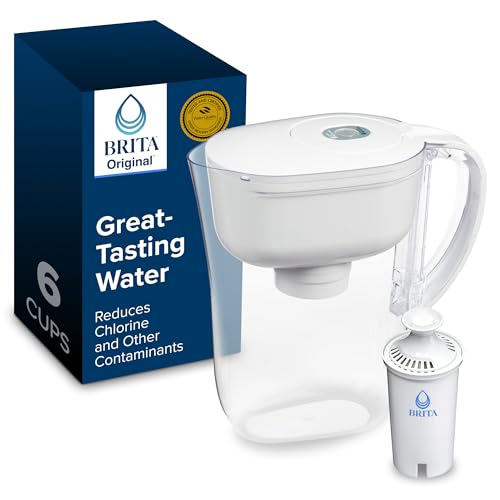
Brita Small 6 Cup Specs: 48 Ounces on a 40 Gallon Cartridge
The Brita Small 6 Cup is a gravity pitcher with a six cup tank, a flip top lid and one Original cartridge in the box. The listing writes its own model field as 0B11/OB03, putting a zero in front of the body code and a letter in front of the filter code, and Brita's performance data sheet settles the difference. Its system model numbers read OB01, OB11, OB21 and OB24 and run on through OB62, with model OB03 as the replacement filter for every one of them. One jug, one cartridge, and a body code the sheet already knows.
Here is what the documents actually say, where they stop talking, and how this shape sits in the pitcher filter rankings we keep.
- Certification: the performance data sheet for the Standard filter, model OB03, prints NSF/ANSI 42 and NSF/ANSI 53 with a full reduction table, and its system model numbers include OB11, the body code on this listing. The sheet names no certifying body on any line, and the listing's own bullet claims "WQA NSF/ANSI certified" without naming a certificate, so there is a claim and no document behind it.
- Certified reductions: chlorine at 95 percent and zinc at 64 percent under 42, then cadmium at 91 and 94 percent, copper at 89 and 73 percent and mercury at 86 and 82 percent under 53, each figure given at pH 6.5 and pH 8.5. Five substances, one of them an aesthetic one, and lead is nowhere on the table.
- Capacity: 6 cups, about 48 ounces, which is 1.4 liters and six eight ounce glasses per fill. Brita's own copy for this shape describes it as space efficient and a fit for most mini fridges.
- Filter life: 40 gallons or about 2 months, whichever arrives first, printed on Brita's pitcher pages and on its replacement filter page in the same words.
- The cartridge itself: 4.12 inches tall, 2.31 across and 0.13 pounds, from the spec block on Brita's own replacement page. A part that size holding 40 gallons is the whole trick of a pour through filter.
- Indicator: an electronic SmartLight indicator on a coin cell, which reads the water you have poured rather than a date you wrote on a sticker.
- Body and care: BPA free plastic throughout, and the pitcher is hand wash only.
- Warranty: Brita's own 30 day money back guarantee on pitchers and filters.
- Price band: $25 to $30 at our last check, in stock and shipped by Amazon itself. Brita's own store lists a 6 cup body with an Original filter in the $20 to $25 band and the same six cup shape with an Elite filter in the $35 to $40 band.
- Category position: rank 2 in Pitcher Water Filters on the same check, which is the busiest shelf in the category and a long way above the ten cup Tahoe in our records.
- Not published: a flow rate, a pressure rating, a micron rating, and a certificate or listing number. Two of those four silences are the reason this pitcher reads 4/7 below.
What that adds up to at your tap: six glasses per fill, a cartridge certified to polish chlorine out of cold municipal water and pull three metals with it, and a light that counts the water instead of a sticker you would have to date yourself.
Here is the part the price tag hides: the tank is the small number and the cartridge is the big one. Forty gallons of filtering capacity pours through a jug that holds six glasses at a time, so the water is cheap and the walking is not. A gallon of drinking every day through this tank is 2.7 fills, which works out at 973 trips to the tap in a year against 584 for the ten cup body running the identical cartridge.
The sheet cannot settle that difference, because the sheet covers the cartridge and the cartridge is the same part in either jug. What changes between the two is how often you carry water across a kitchen. That is a real cost, it doesn't appear on any spec table, and it's the reason a small pitcher and a small household are not automatically a good match.
Think of it this way
A date stamp empties a fridge faster than a thirst does. A quart of milk in a household of one sours on the print date rather than on the last pour, and the fact that nobody was thirsty that week never enters the arithmetic. Brita's two month rule runs the same way: 60 days is 60 days whether the cartridge filtered 40 gallons or 4. Small jugs and small households are exactly where a calendar rule bites hardest.
Brita Small 6 Cup Score: 4 of 7
Every product in this index is rated 1 to 7 across seven verifiable criteria. One point per criterion. No partial credit. I am an enthusiast with a long memory and a spreadsheet, not a lab, and the table below is the entire method in one place.
Each line asks two questions: is the number on the record, and does it hold up against the class. The line stays at zero when the document is missing or the number is the worst in its class. Here, 3 of the 7 points sit at zero, and they are the same three its ten cup sibling posts, because the cartridge in both boxes is the same part. One zero is a limit of the cartridge, one is a limit of the paperwork, and one is a number nobody printed.
| Criterion | Points | Evidence |
|---|---|---|
| Certified removal scope | 0 points | Chlorine and zinc under 42, cadmium, copper and mercury under 53, and no lead and no 401 entry, while the Elite filter that fits this body carries the lead listing |
| Certification and test transparency | 0 points | The listing claims WQA certification without a number, and the sheet prints standards 42 and 53 with a reduction table and names no certifying body at all |
| Filter life and rated capacity | 1 point | 40 gallons and about 2 months, both published, against a 6 cup tank that makes the pair easy to check |
| Cost per gallon | 1 point | Between 12 and 14 cents at rated capacity on the three pack band, which is among the cheapest certified pitcher gallons we track |
| Flow rate and pressure drop | 0 points | No flow rate for the pitcher, the cartridge or the sheet, while ZeroWater publishes 6.5 ounces a minute |
| Install and footprint | 1 point | No plumbing, no tools, 48 ounces of water on a fridge door shelf |
| Maintenance burden | 1 point | Six changes a year at Brita's household figure, which the 2 month interval sets as a floor rather than a target |
The scope line is a limit of the cartridge, not a bookkeeping one. Five substances are on the certified table and lead is not one of them, while the Elite cartridge that drops into this same 6 cup body carries an IAPMO R&T lead listing across a set of pitcher models that includes OB11 and OB60. Two boxes, one body, and the lead paperwork travels with the filter rather than with the jug.
The other two zeros are a page and a measurement. The listing says WQA and names no certificate, and the sheet that carries the actual standards names nobody at all, so there is nothing a reader can key into a certification directory. Brita also publishes no flow figure for a pitcher that takes minutes to move six glasses. A tank of water is a wait, and this record refuses to say how long.
The maintenance point follows the same cartridge record we scored on the Original three pack page, which counts six changes a year as a point because ZeroWater asks for four times as many. That precedent sits in our replacement cartridge comparisons, and the open ruling on the maintenance line has not been answered yet, so this page states which way it read the rule rather than guessing quietly. A six cup tank at 128 ounces daily is 9 changes rather than 6, and that number belongs in the cost section below.
Who the Brita Small Fits: One Desk, One Fridge Door, One Person
The question is never which filter is best. It is which filter matches your tap, your wallet and the contaminant you actually named before you started shopping. This jug answers the volume question above six glasses and answers the lead question by leaving it alone.
Small pitchers sell to small households, and that is exactly the pairing where the arithmetic gets interesting: the tank and the clock fall out of step as soon as there is only one person drinking. If the lead question is the one you brought, the Elite cartridge drops into this same body and carries that listing, and our Brita brand pages lay the two boxes side by side. The 48 ounce shape is also the size our apartment filter shortlist keeps coming back to, because it needs no landlord conversation.
- The dorm room: 48 ounces and a flip top lid are sized for a mini fridge shelf, which is what the listing itself claims and what the shape delivers.
- The office desk: most of a shift of drinking fits in one fill, so the trip to the kitchen happens once rather than at every glass.
- The one person kitchen: the refill rhythm and the cartridge clock separate here, and the cost section below is where that shows up.
- The renter who will not touch plumbing: no tools, no landlord, no invoice, and the whole install is a lid that comes off.
- The taste only buyer: chlorine and zinc off the tap for about 12 to 14 cents a gallon at rated capacity is a real improvement for small money.
This Is Not Your Pitcher If
- You need lead, PFAS or a 401 claim from the box you open. This listing ships the Original cartridge, and its data sheet names none of them.
- You drink a gallon daily or more. That is 973 fills of this tank in a year, and a chore stops being a small one somewhere around the four hundredth.
- You want one purchase instead of a rhythm. Every pitcher here is a subscription with a handle attached, and an under sink filter is the version of this decision that stops repeating.
- You are on hard water. Brita's own guidance says hard water shortens filter life, so 40 gallons is a ceiling rather than a promise in a limescale house.
The way I see it
A 48 ounce jug drinking from a 640 glass reservoir is the whole design in one sentence. The cartridge is rated for 640 eight ounce glasses, and the pitcher it sits in holds 6 of them, so the filter is the patient half of the pair and the tank is the impatient half. You are not buying filtration capacity here. You are buying a countertop decanter and renting the capacity by the calendar.
Brita Small Pros and Cons
What You Get
- 48 ounces for the smallest band in the aisle: six glasses on a fridge shelf with no plumbing, no tools and no invoice.
- A published capacity and a published clock: 40 gallons and about 2 months, both on Brita's product pages, so the running cost can be worked out before the pitcher arrives.
- The cheapest certified gallon in the pitcher tier: roughly 12 to 14 cents at rated capacity, which is a fraction of what the widest spectrum pitcher in our records asks.
- A cartridge the manufacturer's own sheet covers: OB11 is one of the 20 system numbers on the OB03 data sheet, so the documentation applies to this body rather than to the family in general.
- Two standards, not one: 42 for taste and odor, 53 for three metals, with a percentage beside each substance at two pH values.
- A body that accepts the better cartridge: the Elite filter fits, and the listing says so. It triples the interval and adds the lead listing.
What It Costs You
- No lead, no PFAS, no 401: the certified table stops at three metals plus an aesthetic pair, while the same brand sells this 6 cup body with the cartridge that adds both.
- A calendar that retires a tenth used cartridge: at a single glass daily the 2 month clock ends a filter that has poured about 4 of its 40 gallons.
- 973 refills a year at a gallon a day: the tank is the bottleneck, and the trips to the tap never appear on a spec sheet.
- No flow rate anywhere: the patience a gravity pitcher asks for is real, and the number is not published.
- Hand wash only: no dishwasher, which is an annoyance rather than a risk, and it is printed in the care instructions.
- The listing band is not the cheap shelf: Brita's own shop lists a 6 cup body carrying an Original filter below this band. Compare both before you click.
Brita Small Cost Per Gallon: What the Clock Does to the Math
The upfront price is the least useful number on this page. What matters is the the gallon price, and on a cartridge that dies of old age the same 6 cartridges a year can deliver 23 gallons or 182 of them. I have run this arithmetic across every pitcher in the index, and for a chlorine taste fix this jug is one of the cheapest routes there is. It's also the route where the headline figure and the real figure sit furthest apart.
- The pitcher: a $25 to $30 band when we last checked, one Original cartridge in the box, in stock and shipped by Amazon itself.
- The cartridge: the three pack sits in the $14 to $17 band in our records, which is about five dollars a cartridge. Divide by the rated 40 gallons and the gallon costs between 12 and 14 cents.
- Pack maths direct from Brita: a single filter under $10, three filters in the $18 to $19 band and six in the $30 to $35 band, which is about $5 a cartridge at the big pack.
- A year at a single glass daily: six cartridges, because the clock arrives long before the capacity, which is about $28 to $34 for 23 gallons of drinking. That is about 120 to 150 cents a gallon.
- A year at 128 ounces daily: the capacity finally binds, so the year takes 9 cartridges, which is about $42 to $51 for 365 gallons and about 13 cents a gallon.
- The Elite route: the same body takes the Elite filter, rated 120 gallons or about six months, so a year takes 2 cartridges at $19 to $20 each or $32 to $34 for the pair on the brand's own storefront. Same annual money, two orders instead of six, and lead plus 401 added.
Here is the part the price tag hides: the floor of 6 cartridges a year costs the same whether the household drinks 23 gallons or 182. A pitcher gallon is not expensive, and a barely used pitcher gallon is. The lever is not the tank size and it is not the pack size, it is the length of the interval attached to the cartridge.
Think of it this way
A parking meter that charges by the visit rather than by the hour is the honest picture of an Original cartridge. 6 coins a year buys the same meter time for the household pouring one glass daily and the household pouring 64 ounces, and only the second one drives the gallons the filter was built for. You are paying for the calendar either way, so buy the calendar that lasts.
The pack size is the only lever that moves a calendar driven gallon, so compare the three pack against the six.
Brita Small 6 Cup vs the Field
Every row below is a pitcher from our own index, with certifications and capacity taken from the sheets and the catalog records behind this site. Nothing here is a manufacturer comparison chart, and the upfront figures are bands rather than live prices.
| Pitcher | Certified | Rated life | Upfront band |
|---|---|---|---|
| Brita Small 6 Cup | NSF 42, 53 | 40 gal | $25 to $30 |
| Brita 6 cup with Elite filter | NSF 42, 53, 401, lead | 120 gal | $35 to $40 |
| Brita Everyday Elite Pitcher | NSF 42, 53, 401 | 120 gal | $38 to $45 |
| Brita Tahoe 10 Cup Pitcher | NSF 42, 53 | 40 gal | $50 to $55 |
| ZeroWater 10 Cup Pitcher | NSF 42, 53 | 15 gal | $27 to $30 |
The first surprise is that this jug runs the same 40 gallon cartridge as the ten cup body, so the bigger pitcher buys volume rather than filter life. The Tahoe holds 80 ounces to this pitcher's 48, on an identical part, which means 128 ounces daily costs the same in cartridges in both and asks for 389 fewer trips to the tap in the larger one.
A jug sold as the Small, the Metro and the Denali is a spare key cut from three blanks that fit one door, and only the cartridge code tells you which lock you have. The title on this listing says Small, its own bullet copy calls the pitcher a Metro, and the current Brita store sells that same shape as the Denali, in an Original version in the $20 to $25 band and an Elite version in the $35 to $40 band. The names drift, the code on the listing leads with a zero, and the cartridge doesn't drift at all, so shop by the letters on the box.
The second surprise is the upgrade sitting inside the same body. The Elite cartridge is rated 120 gallons or about six months and carries a lead listing that includes this body's code, for a pitcher band in the $35 to $40 row above and a cartridge band around $19 to $20 each. That is the honest upgrade path for a small space, and it costs less per year than the six small orders it replaces.
Third, the budget pitcher tier contains the widest contaminant list in the aisle and the shortest cartridge life in it. The ZeroWater answer to lead and PFAS is real, and its running cost is roughly eight times this jug's. One of those two pitchers is better for your tap and the other is better for your wallet, and only you know which question you brought.
Same cartridge, 80 ounce tank instead of 48, and 389 fewer walks to the sink in a year.
Brita Small FAQ
- Does the Brita Small 6 Cup remove lead?
- Not with the cartridge in this box. The Original sheet names five substances, chlorine and zinc under 42 and cadmium, copper and mercury under 53, and lead is not among them. Brita's lead claim belongs to the Elite filter, whose listing names this body's code among the pitcher models it covers, and a 6 cup body carrying that filter is sold for a higher band.
- How much water does the tank hold?
- Six cups, about 48 ounces or 1.4 liters, which is six eight ounce glasses per fill. A gallon of drinking a day through this tank is 2.7 fills and 973 fills across a year, against 584 for the ten cup body on the same cartridge.
- How often do I change the filter?
- Every 40 gallons or about every two months, whichever arrives first, which is Brita's own published guidance. A household drinking one glass daily still buys 6 cartridges a year, because the calendar is what retires the filter at that volume.
- Can I use Elite filters in this pitcher?
- The listing says this pitcher is compatible with Elite filters, and Brita sells the same six cup shape with an Elite filter in the box. The Elite rating is 120 gallons or about six months, which turns six small orders a year into two and adds the lead listing.
- Why is the gallon more expensive for a light drinker?
- Because the clock retires the cartridge before the capacity does. Six cartridges a year is 28 to 34 dollars whether the household pours 23 gallons or 182 of them, so the effective cost runs from about 12 cents a gallon at 128 ounces daily to about 130 cents at a single glass daily.
Brita Small 6 Cup: Where It Lands in the Pitcher Aisle
The Brita Small 6 Cup earns 4/7, and the three lines at zero are one cartridge limit, one missing certificate number and one missing measurement. It holds 48 ounces on a fridge shelf, it runs a cartridge the manufacturer's own sheet covers on this body code, and at rated capacity it turns tap water into a 12 to 14 cent gallon.
The catch is the calendar. 6 of them a year is the floor whatever you drink, so the household this jug is sold to pays the most per gallon in the aisle, and the same body with the Elite filter fixes that arithmetic rather than the tank.
Buy this pitcher for a desk, a dorm room or a single person who wants the taste complaint gone cheaply. If a gallon a day is your habit, the lead removal shortlist and the ten cup bodies on it should come first, because this tank will ask you for nearly a thousand refills a year to deliver it.
Small tank, honest paperwork, and one cartridge decision worth making before the box arrives.
Where It Lands: 48 Ounces, Six Cartridges, One Calendar
Six glasses per fill, a 40 gallon cartridge at about 13 cents a gallon for a heavy drinker, and a two month clock that sets the bill for everyone else. Chlorine and three metals handled, lead left to the other filter.
Brita Small Lexicon: Every Standard in This Review
- NSF/ANSI 42
- The aesthetic effects standard. It covers chlorine, taste and odor and the particulates that make water look cloudy. A filter with 42 alone improves how water tastes and does nothing for the health list.
- NSF/ANSI 53
- The health effects standard, certified per listing. On this cartridge it covers cadmium, copper and mercury, each with a reduction percentage at two pH values.
- NSF/ANSI 401
- Covers emerging compounds, which includes certain pharmaceuticals, pesticides and flame retardants. The Original cartridge does not carry it, and the Elite filter that drops into this body does.
- Rated capacity
- The volume a cartridge filters before its performance is no longer covered, in gallons. This one is 40, which is 640 eight ounce glasses. It is the honest denominator for any cost comparison, because months depend on how much a household actually drinks.
- Service interval
- The calendar limit the manufacturer attaches to a cartridge, here 2 months. Where a capacity and an interval are both published, the one that arrives first is the one that retires the filter, and on a small pitcher that is almost always the calendar.
- Gravity pitcher
- A jug where water falls through the cartridge under its own weight, with no plumbing and no line pressure. It is why pitchers publish little or nothing about flow, and why the wait is the trade for the price.
- SmartLight indicator
- Brita's electronic filter reminder, powered by a coin cell. It reads the water you have poured rather than a date, so the replacement moment arrives after a volume instead of on an anniversary.
- Model number
- The code that decides which cartridge fits and which certification applies. The sheet lists this body as OB11, the Original cartridge as OB03 and the Elite cartridge as OB06, while the listing writes the body code with a leading zero. Match the cartridge to the letters on the box, not to the code you copied.
Keep Reading: More Brita Small Reviews
- Best Pitcher Water Filters: the parent roundup, every pitcher in the index ranked by Nerd Stamp and the running cost.
- Brita Water Filters Review: the whole Brita lineup, pitchers to faucet mounts, cartridge by cartridge.
- Best Water Filters for Apartments: the no drill shortlist this 48 ounce shape keeps earning a place on.
- The Nerd Stamp Methodology: how the 1 to 7 rating is calculated.