ZeroWater 10 Cup Pitcher: The Cleanest Water, The Highest Bill
The ZeroWater 10 Cup Pitcher makes the widest removal claim in the pitcher aisle. IAPMO R&T certifies its 5 stage filter against NSF/ANSI 42 and NSF/ANSI 53 for lead, chromium, PFOA, PFOS and mercury at a 15 gallon capacity. It ships with the TDS meter that tells you when the cartridge is spent. The catch is arithmetic: one cartridge every 15 gallons, a running cost near a dollar a gallon, and rank 5 in Pitcher Water Filters on the day we last checked.
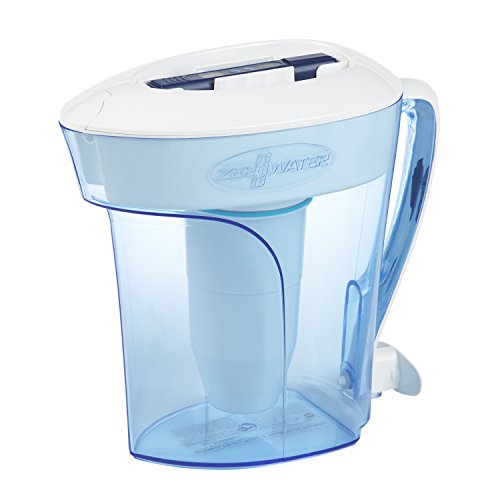
ZeroWater 10 Cup Pitcher Specs: What 15 Gallons Actually Buys
The ZeroWater 10 Cup Pitcher is a gravity pitcher with a five stage ion exchange cartridge, a fill reservoir on top, and a tap at the base. Model ZP-010, and ZeroWater ships a TDS meter in the box, which is the part most of this category leaves out.
ZeroWater sells it as a Ready-Pour pitcher dispenser. For where this one sits against the rest of the aisle, our pitcher filter rankings hold the running list, and here is what the documentation actually says. ZeroWater documents more of this pitcher than most of the aisle does, which is why the argument that follows is about money rather than missing paperwork. The certification is the strongest part of the case, and it is not in dispute anywhere on this page.
- Certification: the 5 stage filter and its compatible pitchers carry an IAPMO R&T system certification against NSF/ANSI 42 for chlorine taste and odor and against NSF/ANSI 53 for reduction of lead, chromium (hexavalent), PFOA, PFOS and mercury, at a 15 gallon capacity. Read that certification sentence twice, because it's the entire case for this pitcher. It's the only pitcher listing on file where PFOA and PFOS appear by name.
- Certified capacity: 15 gallons. Not a marketing estimate. The number in the IAPMO statement.
- Published flow rate: 6.5 ounces per minute, straight from ZeroWater. That's about 12 minutes to move a full 80 ounce tank.
- Capacity: 10 cups, about 80 ounces, or a bit over 2 liters.
- Filtration method: 5 stage ion exchange with carbon, which is why it drives total dissolved solids to near zero instead of just polishing taste.
- Meter: a TDS meter is included. ZeroWater's own instruction is to change the cartridge when the meter reads 006 or higher.
- Materials: BPA free plastic body.
- Warranty: 90 days on the pitcher and the TDS meter, 30 days on the filter cartridge. Both are manufacturing defect warranties, not performance guarantees, and ZeroWater says so in the fine print.
- Price band: $27 to $30 at our last check, in stock, sold and shipped by Amazon.com, buy box winner, carrying a limited time deal. Treat that as a band and check the listing for the live figure.
- Category position: rank 5 in Pitcher Water Filters, and its cartridge two pack sits at rank 3 in Replacement Pitcher Water Filters. The consumable outsells almost everything it fits.
- Not published: the IAPMO listing number, a micron rating, and any gallons per minute figure. Those three omissions cost this pitcher a Nerd Stamp point, and one of them is unavoidable for an ion exchange design.
What that adds up to at your tap: a 10 cup tank that fills in about twelve minutes, a cartridge that quits somewhere around your fifteenth gallon, a meter that answers in numbers instead of moods, and water so stripped of dissolved solids that people call the taste empty rather than clean.
Fifteen gallons is 240 eight ounce glasses. That is about 24 full refills of this tank, or a cartridge every two weeks at a gallon a day. And the fill takes about twelve minutes, which is long enough to start wondering whether the thing is working. It is, slowly.
Think of it this way
Most pitchers sell you a cartridge and a calendar habit. ZeroWater sells you a cartridge and a fuel gauge. The 15 gallon rating is the tank size, the TDS meter is the needle, and the needle doesn't care what month it is. You get to read the end of the filter off a screen instead of guessing at it, which is rarer in this aisle than it should be.
ZeroWater 10 Cup Pitcher Score: 4 of 7
Every product in this index is rated 1 to 7 across seven verifiable criteria. One point per criterion. No partial credit. I am an enthusiast with a long memory and a spreadsheet, not a lab, and the scorecard below is the entire method in one table.
Each line asks two questions: is the number on the record, and does it hold up against the rest of the class. The line stays at zero when the document is missing or the number is the worst in its class. Both of those are things you can go and check for yourself. Missing paperwork and a bad number cost the same here, and on this page that's 3 of the 7 points.
| Criterion | Points | Evidence |
|---|---|---|
| Certified removal scope | 1 point | NSF/ANSI 42 and 53, with the contaminant list named in the certification |
| Certification transparency | 0 points | Standards, contaminants and capacity are stated, but no listing number and no micron rating are published |
| Filter life and capacity | 1 point | 15 gallons, certified, and it is the shortest rating in our pitcher records |
| Cost per gallon | 0 points | About 100 to 120 cents, the highest in our pitcher records, see the math below |
| Flow rate | 1 point | 6.5 ounces per minute, published, and about 12 minutes for a full tank |
| Install and footprint | 1 point | No plumbing, no tools, one counter or fridge shelf |
| Maintenance burden | 0 points | A cartridge every 15 gallons, the most frequent change in our pitcher records |
Three lines sit at zero, and not one of them is about the water. The transparency line is paperwork: ZeroWater publishes a performance data sheet and names its standards, but not the listing number and not a micron rating, and a criterion that wants all three doesn't hand out partial credit. One unpublished listing number costs this pitcher 1 of the 7 points.
The other two lines are the math. A cartridge every fifteen gallons, and the bill that follows it, are simply what the cleanest number in this class costs to run. Three of the 7 points are gone, and only one of them is paperwork.
Who Should Buy the ZeroWater Pitcher: Match the Filter to the Tap
The question is never which filter is best. It's which filter matches your tap, your wallet, and the contaminant you actually named before you started shopping. ZeroWater answers one question better than anything else in the pitcher aisle and answers the budget question worst. That one split decides the rest of this page.
Pick your side. If the bill is what decides it, a faucet mount moves less water for a small fraction of the cents.
- The forever chemicals worrier: this is the pitcher for you. PFOA and PFOS appear by name in the certification, which isn't something the rest of the category can say.
- The heavy metal worrier: lead, chromium (hexavalent) and mercury are all inside the same NSF/ANSI 53 listing.
- The number person: the TDS meter turns filter life from a guess into a reading. If you want evidence instead of a suggestion, this is your pitcher.
- The taste perfectionist: ion exchange drives dissolved solids toward zero, and near zero TDS is why people describe ZeroWater as tasting empty rather than clean.
- The small household: 10 cups is roughly two days of drinking water for one person, which is close to the cartridge's actual working life anyway.
This Is Not Your Pitcher If
- You drink more than half a gallon a day. At a gallon a day you're changing a cartridge every two weeks and buying 24 of them a year. The math below isn't friendly.
- You want the cheapest way to improve tap water. A carbon pitcher or a faucet mount does that job for a fraction of the running cost.
- You're on very hard water or high TDS tap water. ZeroWater's own guidance ties filter life to incoming TDS, and high TDS burns a 15 gallon cartridge faster than the rating suggests.
- You aren't going to check the meter. ZeroWater says replace at 006 or higher. A cartridge past that point is a plastic tube with your money inside it.
The way I see it
A ZeroWater pitcher isn't a purchase, it's a subscription with a plastic handle attached. The pitcher is the cheap part. The cartridge is the product, and you will buy it somewhere between 12 and 25 times a year. Decide whether you are comfortable with that rhythm before you decide whether you like the water.
ZeroWater Pitcher Pros and Cons
What You Get
- The fullest contaminant list in the aisle: the whole NSF/ANSI 53 set, lead and chromium included, with PFOA and PFOS named outright.
- Zero TDS, honestly measured: the included meter lets you verify the filter instead of trusting a calendar.
- Two standards, not one: NSF/ANSI 42 handles taste and odor, 53 handles the health list. Plenty of pitchers stop at 42.
- Cheaper to buy than the premium pitchers: the system sits under $30 at our last check, against $105 to $115 for the Clearly Filtered pitcher in the index.
- Refillable and recyclable at scale: ZeroWater frames one cartridge as up to 110 single use bottles saved, and that arithmetic holds if you actually drink the water.
- Sold and shipped by Amazon: buy box winner, in stock, no third party seller gamble when we last checked.
What It Costs You
- 100 to 120 cents per gallon: the highest running cost in our pitcher records, several times a faucet mount.
- 15 gallons per cartridge: the shortest certified life on this shelf, which makes the pitcher a consumable with a housing.
- Glacial flow: 6.5 ounces a minute means about 12 minutes for a full tank. You will plan around this.
- Paperwork gap: no IAPMO listing number and no micron rating published, which costs a Nerd Stamp point.
- Life depends on your water: high TDS tap water shortens the cartridge below the 15 gallon rating, and the rating is what the cost math is built on.
- Proprietary cartridges: you are buying ZeroWater cartridges for as long as you own the pitcher, and Culligan's newer generation cartridge is a different part. Match the cartridge to the pitcher badge.
ZeroWater Pitcher Cost Per Gallon: The Number the Listing Buries
The upfront price is the least useful number on the page. What matters is the gallon price, and this pitcher is where that metric earns its keep. I have run this arithmetic across every pitcher in the index, and this is the strangest column in the spreadsheet: the cleanest water and the biggest bill, from the same 15 gallon cartridge. The consumable decides the outcome, which is why we keep our own replacement cartridge comparisons, and the two pack is the unit that matters here: at this rating a single cartridge is two weeks of drinking water and nothing more.
- The pitcher: a $27 to $30 band on our last pass, single cartridge included.
- The cartridge: an official 2 pack sits in the $30 to $35 band, which is $15 to $18 per cartridge. Divide by the certified 15 gallons and you get about 100 to 120 cents per gallon. That's the number the listing doesn't show you.
- The same math on the nearest Brita pitcher cartridge: $14 to $17 per cartridge at a 40 gallon rating, which is about 35 to 42 cents per gallon. Roughly a third of the ZeroWater figure.
- And on a Brita faucet mount: $13 to $15 per cartridge at 100 gallons, which is about 13 to 15 cents per gallon. About seven times cheaper per gallon than this pitcher.
- The annual reality: a household drinking a gallon a day burns 365 gallons a year, which is 24 cartridges at ZeroWater's rating. In the cartridge band above, that's roughly $360 to $430 a year on a pitcher that cost under $30. At half a gallon daily, cut it in half.
Here is the part the price tag hides: A dollar a gallon is the highest running cost in the index, and it is roughly two and a half times the Brita pitcher cartridge. Not the highest by a hair, and not a rounding error either.
Think of it this way
Think of a water filter the way you would think about a car. ZeroWater is the fast car with the small tank. It goes further into the contaminant list than anything else on the lot, and it stops for fuel every fifteen gallons. Cheaper than bottled water and several times the cost of a faucet mount can both be true, and here they are.
The 2 pack is where the running cost lives, and the band moves with it.
ZeroWater 10 Cup Pitcher vs the Field
Every row below is a pitcher from our own index, with certifications and capacity taken from our records. Nothing here is a manufacturer comparison chart, and the upfront figures are bands, not live prices.
| Pitcher | Certified | Rated life | Upfront band |
|---|---|---|---|
| ZeroWater 10 Cup Pitcher | NSF 42, 53 | 15 gal | $27 to $30 |
| Culligan ZeroWater 10 Cup Pitcher | NSF 42, 53 | 15 gal | $26 to $30 |
| Brita Everyday Elite Pitcher | NSF 42, 53, 401 | 120 gal | $38 to $45 |
| Brita Small 6 Cup Pitcher | NSF 42 | 40 gal | $25 to $30 |
| PUR 11 Cup Pitcher | NSF 42 | not published | $28 to $32 |
Two things stand out. First, the Culligan branded ZeroWater 10 Cup is the same technology at a similar band, and Culligan sells a second generation cartridge for its own pitchers. Buy the cartridge that matches the badge on the pitcher you own.
Second, the Brita Everyday Elite carries a third standard, NSF/ANSI 401, and a 120 gallon rating for a band not far above this one. Standard 401 covers emerging compounds, not PFAS specifically, and in our certification notes ZeroWater is the only pitcher where PFOA and PFOS appear by name.
You're choosing between the widest contaminant list and the cheapest gallon. No pitcher on file wins both.
Same certified 5 stage water, fewer refills, TDS meter on the lid.
ZeroWater Pitcher FAQ
- Does the ZeroWater 10 Cup Pitcher remove lead?
- Yes, and it is certified rather than claimed. The IAPMO R&T statement names NSF/ANSI 53 for lead and chromium (hexavalent), and names PFOA and PFOS outright. Coverage is tied to the listing, and the listing number itself is not published, which is exactly what our transparency criterion measures.
- How long does a ZeroWater filter last?
- 15 gallons is the certified capacity, and the manufacturer's own estimated filter life is the same figure. ZeroWater also says life varies with the TDS in your tap water and instructs you to replace the cartridge when the included meter reads 006 or higher. Trust the meter over the calendar, because a hard water household gets fewer gallons than the rating.
- Does it remove PFAS?
- The certification names PFOA and PFOS, the two most studied PFAS compounds, and that is a specific and unusual claim for a pitcher. Read labels carefully: the glass dispenser in the same family is marketed around total PFAS, while the certified contaminant list you can hold a manufacturer to is PFOA and PFOS. Named compounds beat the phrase forever chemicals.
- Is it worth roughly a dollar a gallon?
- That depends entirely on what you are removing. Against a Brita pitcher cartridge at about 35 to 42 cents per gallon or a faucet mount at about 13 to 15 cents, you are paying for the widest named contaminant list in the category and a meter that proves it. If you do not need that list, you are overpaying by design, and a carbon pitcher is the honest answer.
- How long does it take to filter a full pitcher?
- ZeroWater publishes 6.5 ounces per minute, which is about 12 minutes to move a full 80 ounce tank. It is the slowest published rate in our records, and it is also the reason the meter exists: the cartridge is working hard, and hard work has a shelf life.
ZeroWater 10 Cup Pitcher: Where It Lands, Cleanest Water and the Highest Bill
The ZeroWater 10 Cup Pitcher earns 4/7, and the three lines that sit at zero are arithmetic rather than water quality. It holds an IAPMO certification against NSF/ANSI 42 and NSF/ANSI 53 that names lead, chromium and both PFAS compounds, it ships with the TDS meter that proves the filter is working, and it drives dissolved solids to a level nothing else in the pitcher aisle reaches.
It also runs around 100 to 120 cents per gallon, asks for a cartridge every 15 gallons, and publishes neither a listing number nor a micron rating, which costs it the transparency point.
If your concern is PFAS or heavy metals and you want a pitcher rather than plumbing, this is the most defensible answer in our records. Just buy the cartridge two pack with the pitcher, and know what you signed up for.
Cleanest water in the class, biggest bill in the class, and both numbers are certified.
Where It Lands: The Widest Contaminant List in the Aisle
Lead, chromium and both PFAS compounds named inside one certified listing, a TDS meter to prove it, and a running cost of about a dollar a gallon. If that trade fits your tap, this pitcher earns its spot.
ZeroWater Pitcher Lexicon: Every Standard in This Review
- Total dissolved solids (TDS)
- Everything dissolved in water that is not water: minerals, salts, metals and ions, measured in parts per million. A low TDS reading is not the same as safe water, but it is the number this pitcher is built to move.
- Ion exchange
- A resin that swaps unwanted ions in your water for ones it would rather release. It is why a ZeroWater pitcher can pull dissolved solids toward zero when a carbon pitcher can only polish taste.
- NSF/ANSI 42
- The aesthetic effects standard. Covers chlorine, taste and odor. A filter with 42 alone improves how water tastes and nothing more.
- NSF/ANSI 53
- The health effects standard. Covers contaminants with documented health impacts, lead, chromium, PFOA, PFOS and mercury among them, certified per listing. This is the standard ZeroWater leads with.
- NSF/ANSI 401
- Covers emerging compounds, including certain pharmaceuticals, pesticides and flame retardants. It is not the PFAS standard, and marketing copy often blurs the two.
- Micron rating
- The pore size a filter is rated to capture, in micrometers. Below 1 micron is where microplastics and cysts start to fall out. An ion exchange cartridge doesn't carry one, and ZeroWater doesn't publish one.
- Rated capacity
- The volume a cartridge filters before performance is no longer certified, in gallons. ZeroWater's is 15. It is the only honest way to compare cost between pitchers, because months depend on how much you drink.
- The 006 threshold
- ZeroWater's own filter change trigger. When the included meter reads 006 or higher, the cartridge is done, and the manufacturer says not to push past it.
Keep Reading: More ZeroWater Pitcher Reviews
- Best Pitcher Water Filters: the parent roundup, every pitcher in the index ranked by Nerd Stamp and running cost.
- ZeroWater Water Filters Review: the whole ZeroWater lineup, pitchers to dispensers, spec by spec.
- Best Under Sink Water Filters: what you graduate to when you own the pipes and want the gallon count to stop mattering.
- The Nerd Stamp Methodology: how the 1 to 7 rating is calculated.