ZeroWater Filters Review: Zero TDS Is a Flex, But at What Cost?
Nobody opens a ZeroWater filters review because they like the taste of water; they open it for a number, and the number is 000. Four records sit in this lineup, and 3 of them are gravity bodies, from a 10 cup pitcher to a 40 cup glass dispenser for a crowd. The fourth is the cartridge that feeds all 3, and it pulls dissolved solids down to a reading a small TDS meter can show you in seconds. It quits at 15 gallons, the shortest certified capacity in the aisle, and the catch is arithmetic: about a dollar a gallon, the highest running cost on the shelf, from the cleanest number in the category.
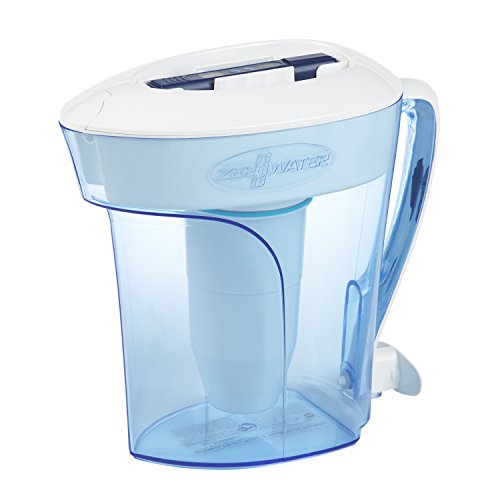
ZeroWater Filters Lineup: 4 Records, 1 Cartridge, 5 Stages
The lineup is 4 records, and it is easy to count. Three of them hold water: the 10 cup pitcher, the 22 cup dispenser and the 40 cup glass. The fourth is the part that feeds all 3, sold on its own as a 2 pack. Every body here is a gravity unit, so nothing in this lineup touches a pipe or a spout.
One cartridge sits inside all 3 bodies, and the stage count does not change between them. That's 5 stages of ion exchange with carbon. It is a different machine from the carbon block most pitchers run, and it is also why the meter on the lid moves toward zero. A household can change tanks without changing what it rebuys, and our pitcher filter rankings hold the rest of the aisle beside it on certification and running cost.
A bigger tank buys fewer trips, not cleaner water.
- Certification: an IAPMO R&T system certification, with NSF/ANSI 42 for chlorine taste and odor and NSF/ANSI 53 naming lead, chromium (hexavalent), PFOA and PFOS and mercury, written against a 15 gallon capacity.
- One cartridge, 3 bodies: the pitcher, the mid dispenser and the glass all take the same part, and the replacement 2 pack is that part sold alone.
- Certified capacity: 15 gallons, about 240 eight ounce glasses, and the shortest rating among the pitcher records we hold.
- Published flow: 6.5 ounces a minute, so a full 80 ounce tank takes about 12 minutes and the 176 ounce dispenser takes about 27.
- Money and mechanism: bodies run from a $25 to $30 band up to an $80 to $90 band on ion exchange resin rather than carbon alone, and the meter in the box ends the cartridge at a reading of 006 or higher.
- No listing number anywhere: the 4 records name a standard or a named compound between them, and not one prints a number a reader can key into a registry.
What that adds up to at your tap: a tank that fills in about 12 minutes, a cartridge that quits around the fifteenth gallon, and a meter that answers in digits rather than moods. The glass holds about 4 times what the small jug does. A single 15 gallon cartridge ends behind both of them.
The way I see it
An ion exchange cartridge is a swap counter, and the stock is finite. Every dissolved mineral that arrives is traded for a hydrogen and kept on the shelf, one for one. Nothing gets caught in a mesh, so the capacity is not about pore size at all. It's about how many swaps are left, and this counter empties at 15 gallons.
ZeroWater Filters Review: 4 of 7 for the 10 Cup Pitcher
Every product in this index is rated 1 to 7 across seven verifiable criteria. One point per criterion. No partial credit. A brand page carries the scorecard of its strongest record rather than an average, and here that record is the pitcher, the only ZeroWater body with a page of its own yet.
Its 3 zeros are the trade this whole lineup makes, and 2 of them are arithmetic rather than water. The pitcher holds the top of the family on removal scope and on flow. What it gives back is capacity and documentation. The full argument sits on the pitcher's own review page, and the table below is copied from it.
| Criterion | Points | Evidence |
|---|---|---|
| Certified removal scope | 1 point | NSF/ANSI 42 and 53, with the contaminant list named in the certification |
| Certification transparency | 0 points | Standards, contaminants and capacity are stated, but no listing number and no micron rating are published |
| Filter life and capacity | 1 point | 15 gallons, certified, and it is the shortest rating in the pitcher aisle |
| Cost per gallon | 0 points | About 100 to 120 cents, the highest figure across the pitcher class, see the math below |
| Flow rate | 1 point | 6.5 ounces per minute, published, and about 12 minutes for a full tank |
| Install and footprint | 1 point | No plumbing, no tools, one counter or fridge shelf |
| Maintenance burden | 0 points | A cartridge every 15 gallons, the most frequent change we have logged here |
One line sits at zero on documentation, and it is the line every page here carries. The standards, the named contaminants and the capacity are all stated, then the record stops short of a number a reader can key into a registry. All 4 records name a standard or a compound list between them, and not one prints a listing number.
The other 2 zeros are the trade. A cartridge that ends at 15 gallons, and the running cost that follows it, are simply what the cleanest reading in this category costs to own over a year.
Who the ZeroWater Filters Fit, and Who They Don't
The question is never which filter is best; it is which one matches your tap and the contaminant you named before you started shopping. This lineup answers 1 question better than anything else in the aisle. It answers the budget question worst of all. Pick your side, then read the running cost.
Capacity is the number to shop on. The tank is the part that scales, and the filter is not. The smallest jug here is about 24 tank fills per cartridge, the mid dispenser about 11, and the large one about 6. One 15 gallon rating, 3 very different rhythms, and the meter ends each at the same 006 reading.
- The PFAS worrier: PFOA and PFOS appear by name in the certification, which is not something the rest of the aisle prints.
- The heavy metal worrier: lead, chromium (hexavalent) and mercury sit inside the same NSF/ANSI 53 listing.
- The number person: the meter turns cartridge life into a reading instead of a guess, and 006 is the trigger rather than a sticker date.
- The taste perfectionist: ion exchange drives dissolved solids toward zero, and near zero is why people call this water empty rather than clean.
- The larger household: the 22 cup and 40 cup bodies mean fewer fills, while the Brita lineup is where the cheaper gallon argument lives.
This Is Not Your Lineup If
- You drink more than half a gallon a day. At a gallon a day this is about 24 cartridges a year, and the math below is not friendly.
- You want the cheapest way to improve tap water. A carbon pitcher or a faucet mount does that job for a fraction of the running cost.
- You're on very hard or high TDS water. ZeroWater ties cartridge life to incoming solids, so a heavy reading burns a 15 gallon part faster than the rating suggests.
- You won't check the meter. A cartridge past a 006 reading is a plastic tube with your money still inside it.
Think of it this way
A bigger tank is fewer walks and the same ending. The small jug is about 24 fills before the part quits, the middle-sized one about 11, and the large one about 6. Picture the same 15 gallons poured through 3 different buckets. The water is identical, and the extra plastic only buys you fewer trips to the kitchen.
What the ZeroWater Filters Get Right
The strength of this lineup is the contaminant list, and the weakness is the documentation and the burn rate. Every record here names a standard or a named compound, and 1 cartridge feeds every body. The meter also settles the argument about when to rebuy. The rest is arithmetic you can do before you spend anything.
What You Get
- The widest named list in the pitcher aisle: lead, chromium and both PFAS compounds inside one certified scope.
- Zero TDS, honestly measured: the included meter lets you verify the part instead of trusting a calendar.
- Two standards, not one: 42 handles taste and odor, 53 handles the health list, and plenty of pitchers stop at the first.
- Cheaper to buy than the premium pitchers: the small jug sits under $30, against $105 to $115 for the Clearly Filtered pitcher on file here.
- One part across 3 bodies: a household can move from the jug to the glass tank and keep rebuying the same cartridge.
What It Costs You
- About a dollar a gallon: the highest running cost across the pitcher aisle, several times a faucet mount.
- 15 gallons per cartridge: the shortest certified life in the aisle, which makes the jug a consumable with a housing around it.
- Glacial flow: 6.5 ounces a minute means about 12 minutes for a full tank, and you will plan around it.
- A documentation gap: no listing number and no micron rating printed, which costs the record a point.
- Proprietary cartridges: Culligan's newer generation part is a different cartridge, so match the part to the badge on the body you own.
What ZeroWater Filters Cost per Gallon
Every figure below is a band, because retail prices move. The only honest way to compare these parts is the cartridge divided by the gallons it is rated for. No lineup in the index makes that division matter more than this one. A 2 pack in the $30 to $35 band works out to about $15 to $18 per cartridge at the last read, and that is the number the listing keeps to itself.
- The pitcher cartridge: $15 to $18 against a certified 15 gallons, which is about 100 to 120 cents a gallon.
- The same division on a Brita pitcher part: $14 to $17 at 40 gallons, near 35 to 42 cents, roughly a third of this figure.
- And at the spout: a Brita faucet mount part at $13 to $15 over 100 gallons, about 13 to 15 cents, or close to 7 times cheaper on the gallon.
- The bodies: $25 to $30 for the small jug, $45 to $50 for the 22 cup dispenser and $80 to $90 for the glass, and all 3 run the same consumable.
- The annual reality: a gallon a day is 365 gallons a year, which is about 24 cartridges at the 15 gallon rating, or roughly $360 to $430 behind a body that cost under $30.
Here is what the listing leaves out: A dollar a gallon is roughly 2.5 times the Brita pitcher part and about 7 times a faucet mount. That's not a rounding error, and it isn't a hair either. The cleanest number on the shelf is also the most expensive one to keep.
Put another way
Every 15 gallons has a tollbooth on it. The booth doesn't care how fast you drank the water or which body you poured it from. It charges about $15 to $18 a cartridge, which works out near a dollar for every 4 glasses. Picture paying that at the end of every 240 glasses and the running cost stops being abstract.
The 2 pack is where the running cost lives, and the band moves with it.
ZeroWater Filters Review: The 4 Records Side by Side
Every row below is a record from our own index, with the standards and the compounds taken from the documentation rather than a maker's chart. Nothing here is a comparison the brand wrote. The points column carries each part's own page score, and 3 of the 4 rows are still waiting for the page that scores them properly.
| Part | Class | Standard named | Cartridge | Upfront band | Points |
|---|---|---|---|---|---|
| ZeroWater 10 Cup Pitcher (ZP-010) | 10 cup pitcher | 42, 53 | 15 gal | $25 to $30 | 4/7 |
| Culligan ZeroWater 22 Cup Ready-Read (ZD-022-RR) | Dispenser | none named | 15 gallons | $45 to $50 | not scored |
| Culligan ZeroWater 40 Cup Glass (ZEROD40) | Dispenser | no standard printed | 15 gal rated | $80 to $90 | not scored |
| ZeroWater Replacement Filter 2 Pack (ZR-017) | Cartridge pack | none printed | the same part | $30 to $35 | see the review |
Two things fall out of that table. The pitcher is the only record naming a standard number. It is also the cheapest body in the lineup. The 2 dispensers cost more, hold more and name less, which is the inverse of how the aisle usually sorts.
That's a pattern the Culligan lineup shares. Culligan owns ZeroWater and sells the identical part under its own badge. The Brita lineup answers the same question at 35 to 42 cents, and the Clearly Filtered page is where the longest contaminant count in the pitcher aisle lives.
You're choosing between the widest named list and the cheapest gallon.
The filter set that fits every body in this lineup, from the jug to the glass.
ZeroWater Filters Review FAQ
- Is ZeroWater worth the running cost?
- That depends on what you're removing. Against a Brita pitcher cartridge near 35 to 42 cents or a faucet mount near 13 to 15 cents, you're paying for the widest named contaminant list in the category and a meter that proves it. If you don't need that list, a carbon pitcher is the honest answer.
- Does ZeroWater remove lead and PFAS?
- Yes, and it's certified rather than claimed. The IAPMO statement names NSF/ANSI 53 for lead and chromium (hexavalent), and names PFOA and PFOS outright. Named compounds beat the phrase forever chemicals.
- How is ZeroWater different from a Brita pitcher?
- ZeroWater trades ions rather than only filtering through carbon, which is why the meter drops toward zero and the cartridge ends at 15 gallons. Brita runs a longer part at a much cheaper gallon, and 5 of its 9 records name the health list. One buys purity, the other buys cents.
- Do all ZeroWater pitchers and dispensers take the same filter?
- The jug, the middle dispenser and the glass all take the same 5 stage part, and the replacement 2 pack is that part sold alone. What changes across the bodies is the tank, so a bigger one means fewer fills and a 15 gallon part at the end.
- What does 000 TDS actually mean?
- TDS is total dissolved solids, and 000 is a reading rather than a health claim. It means the dissolved minerals and salts have been swapped out, which is why the water tastes empty and why the replacement cartridge matters so much. A low reading isn't a safety certificate, and this site treats it as a number rather than a promise.
ZeroWater Filters Review: Where the Lineup Lands
The lineup sorts into one part and 4 vessels. Every record here runs the same ion exchange cartridge. That cartridge decides the standard, the capacity and the cents. The plastic decides only how many times you walk to the kitchen with an empty jug.
The pick is the smallest body. It is the only record here naming a standard number, the cheapest of the 4 to buy, and the one whose 15 gallons you can watch arrive on a meter.
Start with the contaminant you can name, then let the per gallon figure pick. If lead or PFAS is the reason you're reading, this is the most defensible pitcher we've logged, and the running cost is the price of that certainty. If the budget is the reason, a carbon pitcher or a faucet mount does the job near 13 to 15 cents.
Cleanest reading in the aisle, highest bill in the aisle, and both figures are certified.
Where It Lands: The Meter Is the Only Honest Part
The standard is named, the compounds are named, and the 15 gallon clock is printed rather than guessed. Whichever body you pick, a meter tells you when the cartridge is done, and the cleanest reading on the shelf carries the highest running cost. Pick the tank for the pour, and expect to rebuy the part often.
Every Standard the ZeroWater Filters Name
- NSF/ANSI 42
- The aesthetic effects standard, covering chlorine, taste and odor. A filter with 42 alone changes how water tastes and nothing more.
- NSF/ANSI 53
- The health effects standard, certified per listing, covering lead, chromium, mercury and named compounds. This is the standard ZeroWater leads with, and PFOA and PFOS sit inside it on the pitcher's record.
- NSF/ANSI 401
- Emerging compounds, a separate listing from the health standard, covering certain pharmaceuticals and flame retardants. None of these 4 records name it.
- Total dissolved solids
- Everything dissolved in water that isn't water: minerals, salts, metals and ions, measured in parts per million. A low reading isn't the same as safe water, but it's the number this lineup is built to move.
- Ion exchange
- A resin that swaps unwanted ions in your water for ones it would rather release. It's why a ZeroWater body can pull dissolved solids toward zero when a carbon pitcher can only polish taste.
- Micron rating
- The pore size a filter is rated to capture, in micrometers. An ion exchange cartridge doesn't carry one, and ZeroWater doesn't publish one.
- Rated capacity
- The volume a cartridge filters before performance is no longer certified, in gallons. Here it's 15, which is the only honest way to compare running costs between pitchers.
- The 006 threshold
- ZeroWater's own change trigger. When the included meter reads 006 or higher, the cartridge is done, and the manufacturer says not to push past it.
Keep Reading: More ZeroWater Filters
- Best Pitcher Water Filters: the parent roundup, every pitcher in the index scored the same way.
- ZeroWater 10 Cup Pitcher Review: the record this page carries, row for row, with the full specs.
- Best Water Filters: the pillar, 136 records across 12 classes and one scoring rule.
- The Nerd Stamp Methodology: how the 1 to 7 rating is calculated and what each line asks.