Best Water Filters for Apartments: Clean Water Without Drilling a Single Hole
A house can cut a hole in its counter and a rental can't, and the best water filters for apartments are the ones that never ask for the hole. Both records here are the same Brita 6 cup jug with a tank of about 48 ounces, and the only difference is the cartridge in the box: a 40 gallon Original or a 120 gallon Elite. This page sorts the class by what it asks of the room.
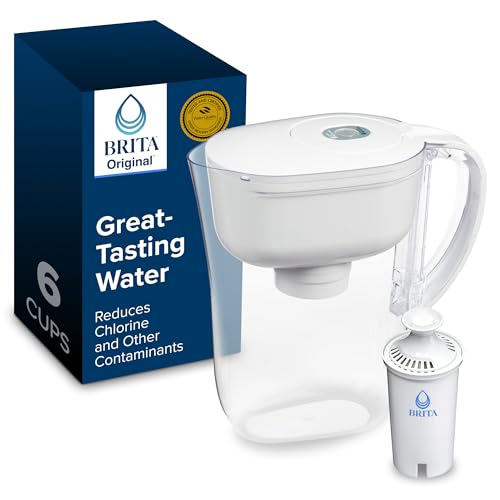
Best Water Filters for Apartments: Zero Holes, Zero Tools
In a rental a filter has to arrive and leave without a trace, so this class is sorted by footprint before it's sorted by water. A jug pours from a shelf, a faucet mount threads onto a spout in a minute, and a countertop unit keeps a plug and a slice of counter. None of the 3 needs a landlord.
The shelf is the narrowest in the index, because both rows are 1 body with 2 different cartridges in it. Brita's 6 cup Metro tank holds about 48 ounces, which is 6 cups, and the box carries either the Original filter or the Elite one. The Original is rated 40 gallons and roughly 2 months, against 120 gallons and about 6 months for the Elite. Same plastic, 3 times the interval.
The documents are where the pair splits, and it splits on 1 line. The Original filter's sheet prints standards 42 and 53 across a full reduction table, and names no certifying body on any line. The Elite listing claims WQA certification for lead, microplastics and pharmaceuticals, names no standard number in that bullet, and leaves the capacity field on our own shelf blank. One box prints the figure and the other prints the claim.
- Footprint: 6 cups, about 48 ounces, on a shelf in the fridge door, with no plumbing and no tools.
- Filter life: 40 gallons or roughly 2 months on the Original, 120 gallons or about 6 months on the Elite.
- Standards named: 42 and 53 on the Original's sheet, the same pair on the Elite's listing, and no listing number on either box.
- Lead: on the Elite's certified list and off the Original's reduction table, the 1 line that separates the boxes.
- Interval: 6 changes for the short cartridge and 2 for the Elite, on the identical body.
- Never published: a flow rate, and a filing number a reader could key into a registry.
What that adds up to at your glass: 2 rows that need no drill and no plumber, 1 interval of 2 months and 1 of 6, and 0 of the pair with a listing number. The full index rates 136 records on the same 7 lines, and this is the only shelf where choosing badly can cost a deposit.
Think of it this way
A fridge door shelf is the smallest parking space in the house. A tank this size is about 48 ounces, which is 3 pounds of water in a slot the width of a cereal box, and it wants no outlet, no hole and no wall. You don't install a jug. You park it.
Best Water Filters for Apartments Score: 4 of 7 for the Pick
Every product in this index is rated 1 to 7 across seven verifiable criteria, with 1 point per criterion and no partial credit. The pick here is Brita's small jug with the Original filter, and its card is copied row for row from the review of that pitcher rather than rescored on this page.
Four lines take a point and 3 stay at zero, and every zero is a document rather than a glass of water. The tank is small, the interval is 2 months, and 12 to 14 cents a gallon is among the cheapest certified gallons in the pitcher aisle. What the record won't print is a flow rate, a filing number, and a lead line on the certified table. Two silences and 1 gap in the removal scope.
| Criterion | Points | Evidence |
|---|---|---|
| Certified removal scope | 0 points | Chlorine and zinc under 42, cadmium, copper and mercury under 53, and no lead and no 401 entry, while the Elite filter that fits this body carries the lead listing |
| Certification and test transparency | 0 points | The listing claims WQA certification without a number, and the sheet prints standards 42 and 53 with a reduction table and names no certifying body at all |
| Filter life and rated capacity | 1 point | 40 gallons and about 2 months, both published, against a 6 cup tank that makes the pair easy to check |
| Cost per gallon | 1 point | Between 12 and 14 cents at rated capacity on the three pack band, which is among the cheapest certified pitcher gallons we track |
| Flow rate and pressure drop | 0 points | No flow rate for the pitcher, the cartridge or the sheet, while ZeroWater publishes 6.5 ounces a minute |
| Install and footprint | 1 point | No plumbing, no tools, 48 ounces of water on a fridge door shelf |
| Maintenance burden | 1 point | Six changes a year at Brita's household figure, which the 2 month interval sets as a floor rather than a target |
Water Filters for Apartments: Which Room It Has to Live In
The room decides before the water does, and a rented kitchen usually offers 1 of 3 surfaces. The door of a mini fridge takes a jug, a spout takes a faucet mount filter, and a free corner of counter takes a countertop unit that plugs in. Measure the shelf before you read the contaminant list.
The one thing a tenant can't fix sits behind the wall, and it's the pipe rather than the supply. Lead arrives from a building's own plumbing and solder in older stock, so the last 3 feet at the glass are the only part of the chain you own, which is where the Elite cartridge's lead listing and a reverse osmosis system both earn their place. You can ask a landlord about the pipes, and you can't ask for a new glass.
This Is Not Your Apartment Filter If
- You have a spare outlet and a free counter corner. Then the tank belongs on the counter rather than in the fridge, and a jug is 48 ounces you carry for no reason.
- Four people drink a gallon a day between them. That's 8 or more fills of a 6 cup pitcher, and the calendar retires the cartridge every 2 months whether or not it kept up.
- Your building's plumbing is new and your water report is clean. Then the lead line is already handled upstream, and the Original cartridge covers the chlorine and the taste for less.
- You want the water filtered at the spout with nothing to fill. That's a faucet mount, and it leaves the fridge shelf for the food.
The way I see it
A countertop filter is a microwave and a jug is a bowl. Both put filtered water in the same glass, and only 1 of them keeps a permanent claim on the surface you cook on. In 40 square feet of kitchen, that difference decides where you chop.
Water Filters for Apartments: The Trade Offs
The trade here is coverage against the room, and the room wins. A jug treats what you drink and nothing else. An entry point system reaches the shower, the laundry and the water heater from 1 decision, and a tenant can't install one. The smaller machine is the one that fits.
What the cheap end gives you is a jug that moves house with you. The body is about 48 ounces of plastic, 1 filter in the box, and no fitting that stays behind when the lease ends. Portability is a feature you notice once, at the loading dock.
The shelf also asks you to accept 2 small waits, and both are counted in the interval. The small tank has to be refilled more often than a 10 cup body, and the 2 month rule retires a cartridge whether it poured 40 gallons or 4. The small tank is the chore and the long interval is the fix.
What You Get
- A tank of 48 ounces on a door shelf, with no plumbing, no tools and no permission slip.
- 12 to 14 cents a gallon at rated capacity, among the cheapest certified gallons in the pitcher aisle.
- 1 body that takes the Elite cartridge, so the lead listing is a filter swap rather than a new jug.
- A pitcher that moves in a box, with nothing behind the wall to patch or explain.
What It Costs You
- A small tank, which is about 2.7 fills for a gallon, so 2 people empty it twice at dinner.
- 6 cartridge changes a year at Brita's household figure, against 2 changes a year on the Elite.
- No flow rate published, so the wait at the glass is a number nobody printed.
- 0 records on this shelf with a listing number, so the filing stops at the standard.
Water Filters for Apartments Running Cost: 2 Clocks on 1 Body
Two clocks run on 1 body, and the calendar sets the bill rather than the water. The Original cartridge carries a 40 gallon rating and a 2 month interval, so a light household retires it with most of the rating still inside. The Elite stretches the same job to 120 gallons, on a 6 month clock. The plastic matches and the calendar doesn't.
The per gallon figure here already absorbs that waste, and it's still the cheapest gallon on the pitcher shelf. Brita's Original filter lands between 12 and 14 cents a gallon at rated capacity, against an aisle that runs near a dollar a gallon on the ion exchange records. The interval is what the cents figure hides: 1 cartridge at 12 cents can cost more a year than 1 at 15 if the calendar retires it early. Cheap by the gallon isn't the same as cheap by the month.
- The entry band: the Original 6 cup sits in a $25 to $30 band when we last looked.
- The step up: the Elite version of the same body lists in the mid $30s.
- The interval: 6 cartridge changes in 12 months on the small tank, against 2 on the long cartridge.
- The missing figure: neither record prints a cartridge price, so the yearly bill is a band rather than a number.
- The floor under the bill: the 2 month rule, which charges the same whether the tank poured 40 gallons or 4.
Here is the catch the copy skips: a $25 jug and a $35 jug run the same body, and the interval is what you actually pay for.
Put another way
Twelve months on the small jug is 6 cartridges, which is under a pound of carbon and plastic. Each 1 weighs about 0.13 pounds, so a year of the short cartridge fits in a shoebox, and a year of the long 1 is 2 objects. Fewer things in a kitchen drawer is a real feature in 40 square feet.
Best Water Filters for Apartments Compared
Both rows come off our own shelf: the standard each 1 names, the gallons it's rated for, the band the listing sits in and the points its card carries. The pick's 4/7 is copied from the review of that pitcher, and the other row reads not scored because it has no page of its own yet.
| Jug | Standard named | Rated life | Upfront band | Points |
|---|---|---|---|---|
| The 6 cup Metro, Original filter (B09W4PLVQP) | 42 and 53, no lead line | 40 gallons, about 2 months | a $25 to $30 band | 4/7 |
| The same Metro body, Elite cartridge (B09W4PJMGZ) | the same pair, plus lead | 120 gallons, about 6 months | the mid $30s | not scored |
The 2 rows differ on 1 line and 1 interval, which makes this the shortest comparison table in the index. The Brita lineup runs that cartridge across more than 1 body, and the 6 cup Metro review is where the pick's card was built.
One body, 2 cartridges, and the lead line is the only thing that moves.
Water Filters for Apartments: FAQ
- What are the best water filters for apartments
- The 2 records on this shelf are the same Brita 6 cup jug with either the Original or the Elite filter in the box, so the choice is the cartridge rather than the tank. For lead in an older building, the Elite row is the 1 whose certified list names it. For chlorine and taste alone, the Original is the cheaper gallon.
- Do apartment water filters need a plumber
- Not 1 of the records here does. A jug wants a fridge door, a faucet mount threads onto the spout by hand, and a countertop unit wants a plug, so nothing on this shelf asks for a shutoff valve or a hole in a counter.
- Can a 6 cup pitcher keep up with 2 people
- It can, at the price of the walk. A 48 ounce tank is about 2.7 fills for a gallon, so 2 people drinking a gallon a day refill it near 3 times, and the calendar retires the cartridge every 2 months regardless of what it poured.
- Does a pitcher remove lead from apartment tap water
- The Original filter doesn't list it. Its sheet prints standards 42 and 53 across 5 substances and lead isn't 1 of them, while the Elite cartridge that drops into the same body carries a lead listing. Check which filter is in the box before you buy the jug.
- How much does an apartment water filter cost
- The 2 jugs sit in a $25 to $30 band and a mid $30s band, and neither listing prints a cartridge price, so a yearly figure is the 1 this shelf won't quote. The interval is where the money hides: 6 cartridges a year on the small tank against 2 on the Elite cartridge.
Best Water Filters for Apartments: Where It Lands
The pick is the 6 cup Metro jug with the Original filter: about 48 ounces on a fridge shelf, no drill and no plumber, at the cheapest gallon on the pitcher shelf. Its 3 zeros are the lead line, the filing and the flow figure.
For a building with lead in its own plumbing, the Elite cartridge is the upgrade, because the lead listing travels with the filter rather than with the jug. It stretches the interval from 2 months to 6, and the 2 rows share a tank, a lid and an indicator. Same body, 1 line of paperwork apart.
Start with the surface you actually have, then let the interval pick the cartridge. A fridge door takes the jug, a spout takes the mount, and a corner of counter takes a unit that plugs in. Add the lead question last, because it's the 1 a renter can't answer at the wall. The room picks the format and the pipes pick the cartridge.
Two records cover a rented kitchen, and both leave the building exactly as they found it. Everything else in the index wants a hole, a valve or a wall, which is the subject of the under sink systems shelf. A deposit is a number, and nothing here puts it at risk.
Nothing Here Leaves a Mark
A jug, a mount and a countertop unit are the 3 formats that fit a lease. The tank decides the format and the calendar decides the bill.
Water Filters for Apartments: Every Standard Named Here
- NSF/ANSI 42: the aesthetic standard, chlorine, taste and odor. It's the cheapest 1 to hold and the 1 most cosmetic claims lean on.
- NSF/ANSI 53: the health effects list, where lead, cadmium, copper and mercury sit. The Original filter's sheet covers 3 of those metals and skips lead.
- NSF/ANSI 401: 15 emerging compounds, from pharmaceuticals to pesticides. It's a separate listing from 53 and separate again from PFAS.
- NSF/ANSI 372: not a water standard. It certifies the materials in the plumbing rather than anything the water carries.
- Rated capacity: the gallons a cartridge is documented to treat, 40 on the Original and 120 on the Elite.
- Change interval: the calendar limit that retires a cartridge first, 2 months on the Original and 6 on the Elite.
- Ion exchange: the mechanism the ZeroWater records lean on, trading dissolved minerals 1 for 1, which is why those cartridges run out at 15 gallons.
- SmartLight indicator: a counter that reads the water poured rather than a sticker you date yourself, fitted to both boxes here.