Water Filter Replacement Schedule: How Often by Type, Brand, and Usage
A filter cartridge carries 2 numbers, and the water filter replacement schedule printed on the box shows only 1 of them. The capacity is the gallons a part can work through, and the interval is the months a maker allows. Your draw is what turns one into the other. This page covers what each class publishes, the arithmetic that sets your date, and what a year of parts costs.
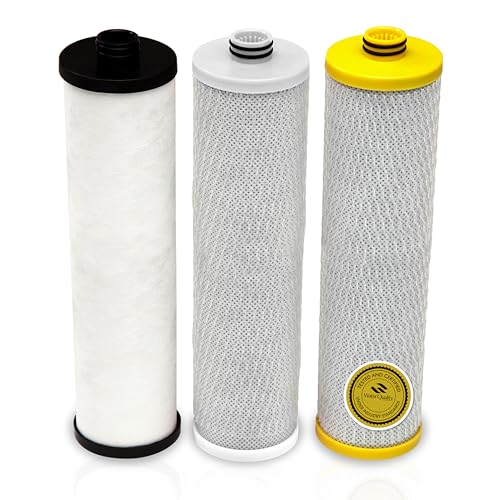
Water Filter Replacement Schedule: 2 Numbers, 1 Date
Two figures retire a cartridge, and a box usually prints one of them. Rated capacity is the gallons a part is built to process before the media gives out. Your draw is what your household runs through it in a day. A maker's date is the first figure divided by that maker's guess at the second.
The published half here is almost always the volume. 45 of the 136 records in this index carry a life figure, and all 45 are written in gallons. None is filed as a duration, so the months on a box come from the copy rather than the record.
Run either number against a real kitchen and the other one moves. A 200 gallon part in a house drawing 2 gallons a day empties in 100 days. The same part in a house drawing 4 empties in 50. Nothing about the cartridge changed, and the schedule moved by 8 weeks.
Divide the capacity by your draw and the box's date stops being the answer.
- The published half: 45 of the 136 records print a gallon figure, from 1 gallon up to 600,000.
- The unpublished half: 0 of those 45 files a number of months, so an interval is a claim rather than a record.
- The divisor is yours: 1 gallon a day is about what 1 person drinks, so a household of 4 moves 4 times the volume through the same part.
- Where the 2 halves split: a 6 month claim on a 200 gallon rating asks for about 364 gallons the part isn't rated to hold.
What that adds up to at your tap: dividing capacity by draw gives you a date. That date belongs to your kitchen rather than to the box. Keep whichever figure arrives first and the cartridge retires before either claim breaks.
Think of it this way
A water cartridge and a furnace filter are sold with the same promise and kept on the same kind of schedule. The panel says 3 months. Your house decides whether that's 6 weeks or 5 months, and the dust, the pets and the fan hours do the talking. The box knows the product, your house knows the interval.
Rated capacity against rated capacity: the whole spread is ranked in the long life roundup, which sorts this same field from the top down.
Water Filter Replacement Schedule Scorecard: 4 of 7 for the Longest Clock
Every record in this index is rated 1 to 7 across seven verifiable criteria. One point per criterion, no partial credit. The pick for a page about intervals is the part that asks for the fewest of them, and that's Aquasana's AQ-5300+R cartridge. Its card is copied row for row from the review of that part.
Four lines take a point and 3 sit at zero, and the 2 document zeros matter more here than the money one. The part publishes 800 gallons and a 6 month interval together, which is rare here. It names 78 contaminants with a reduction figure beside each.
What the listing leaves out: 800 gallons at a 2 gallon draw is about 400 days of water. A 6 month clock retires the part at 182, so 436 gallons are still inside it when the calendar comes around.
| Criterion | Points | Evidence |
|---|---|---|
| Certified removal scope | 1 point | 78 contaminants named with a reduction figure beside each, and the PFAS protocol folded into 53 |
| Certification and test transparency | 0 points | WQA is named and a Performance Data Sheet is published, and there is no listing number anywhere and the blocks carry no micron figure |
| Filter life and rated capacity | 1 point | 800 gallons and 6 months, both published, and the longest rating on this shelf |
| Cost per gallon | 0 points | About 48 to 52 cents once the interval is applied, roughly 4 times the figure on the box and second only to the ZeroWater part |
| Flow rate and pressure drop | 0 points | 0.72 gpm belongs to the assembly, and the cartridge is sold with no flow figure of its own |
| Install and footprint | 1 point | A quarter turn on a housing you already own, no hoses to disconnect, no plumber |
| Maintenance burden | 1 point | 2 changes a year, the fewest on this shelf, against about 6 for the Brita part and about 24 for the ZeroWater one |
The 4 points are the lines a schedule can be built on, and the 3 zeros are where a date goes soft. The difference between a 4 and a 6 here isn't a cartridge, it's a sheet of paper.
The scoring rubric counts a missing listing number as a transparency gap, not a fault. A schedule is only as solid as the smallest number behind it.
What Moves Your Water Filter Replacement Schedule
Five things move the date, and 4 of them are habits rather than hardware. How much you drink, how many people you feed, and what the water carries. Then how hard the machine works, and how long the house sits empty. The cartridge is the constant and your household is the variable.
Draw is the biggest mover. A 2 person flat and a family of 5 can share the same 200 gallon part. One finishes it a month before the other. Guests are the quiet reason a cartridge dies early.
The water itself moves it too. Sediment, iron and hardness load the media faster. A whole house body on a private supply does more work than one on treated city water. The well water roundup starts with a lab test for exactly that reason.
Temperature and idle time finish the list. A house that empties for a month barely ages the part, and storage isn't a figure any box prints.
This Is Not Your Schedule If
- You want one date for every filter: a pitcher part and a membrane are 2 different clocks, and the map that holds them is the replacement cartridge index.
- You want to skip the arithmetic: dividing capacity by draw is 1 line of math, and it's the only figure that belongs to your house.
- You want the longest part in the estate: a 100,000 gallon rating is a durability number rather than a schedule, which is why the membrane class prints no life figure at all.
The short version
Sunscreen is measured at a thickness nobody applies, and a replacement interval is measured at a draw nobody keeps. The SPF on a bottle is a lab figure taken at 2 milligrams per square centimeter, and the real number depends on how you use it. A filter interval is that same kind of number, which is why yours is a calculation.
Water Filter Replacement Schedule: What You Gain, What It Costs
Running the 2 numbers yourself buys 2 things and charges you 1. You stop throwing away capacity that's still good. You stop drinking through media that's already spent. What it costs is a note on the calendar, and that's the whole ask.
The gain is largest in the classes that publish the least. A cartridge with an honest gallon figure lets you run the division and stretch the part. On an 800 gallon rating that can be 200 extra days of water. A class that publishes nothing hands the decision back to a printed date, which is a guess about somebody else's house.
The cost is the error in both directions. Change a part 2 months early and you pay for the same water twice. Change it 2 months late and the taste goes and the flow slows.
What You Get
- One division that turns a gallon figure into a date your kitchen can hold.
- A reason to stretch a part that is still inside its rating, which is most of the capacity on an 800 gallon cartridge.
- A shortlist where the number is published: 45 records of the 136 print a capacity, and the pitcher, spout and cartridge shelves carry most of them.
What It Costs You
- A draw figure you have to estimate, since nobody measures what a household drinks.
- The interval, applied 1 class at a time, because a pitcher part and a cabinet cartridge assume different houses.
- An early change when the water is hard or the house is full, which no record here predicts for you.
The filter choosing guide runs the same exercise on standards rather than on intervals.
Filter Replacement Schedule Costs, Priced by the Part
A replacement schedule is a cost per year dressed as a date. Parts a year is draw times 365 divided by capacity. The band per part is what you'll hand over each time the number comes around. The shelf price shows you the second figure and nothing at all about the first.
A household drawing 2 gallons a day runs about 730 gallons a year. At 13 to 17 cents a gallon that's roughly $95 to $125 of parts. At 6 to 8 cents it's about $45 to $60. Same water, and the annual bill lands 3 times apart.
The half of the story the tag drops: a cheap part on a short interval can cost more over a year than a dear part on a long one, and the gap runs to 4 times. The cartridge comparison and the high flow roundup both sort on that running figure.
- Under 20 cents a gallon: the pitcher and spout classes, where a part is cheap and the cycle is short.
- About 45 to 60 cents: the under sink cartridge band once the interval is applied to an 800 gallon rating at a light draw.
- Under 1 cent a gallon: the whole house bodies, where the cylinder serves every tap and the money is spread over 600,000 gallons.
- The year at a 2 gallon draw: about $45 at the bottom of the estate and about $380 at the top.
The band to watch is the one where the part is cheap and the calendar is short. A 40 gallon jug part and an 800 gallon cabinet part can sit $10 apart on a shelf. A year later they're 4 times apart.
Put another way
A replacement interval is a punch card with an expiry date on it. The card holds 10 punches, and the shop decides when it stops being valid. Draw the water slowly and you walk away with 3 of them unused. The part never got a chance to use the capacity you paid for.
Replacement Schedule by Filter Class, Side by Side
An interval implies a draw, and the implied draw is different in every class. Divide a published capacity by the printed interval in days. That gives the gallons a day which makes the 2 numbers agree. That figure is the assumption a maker is making about you.
The spread in that assumption is the real problem. A jug part implies about 0.7 gallons a day and a cabinet cartridge about 4.4. One word, 2 classes, 6 times the household.
| Class | A published capacity | Interval a box prints | The draw that reconciles them | Publishes a life figure |
|---|---|---|---|---|
| Faucet mount | 100 to 350 gal | about 3 months | 1.1 gal a day | 6 of 8 |
| Pitcher | 40 to 200 gal | about 2 months | 0.7 gal a day | 6 of 18 |
| Refrigerator | 200 to 300 gal | about 6 months | 1.1 gal a day | 4 of 11 |
| Replacement part | 40 to 800 gal | about 6 months | 4.4 gal a day | 4 of 11 |
| Under sink | 800 to 22,000 gal | 6 to 12 months | 4.4 gal a day | 10 of 22 |
| Whole house | 100,000 to 600,000 gal | about 12 months | 274 gal a day | 3 of 10 |
| Reverse osmosis | no life figure filed | about 24 months, membrane | not published | 0 of 18 |
Read left to right and the table answers 1 question: which number arrives first in your house? For a light draw it's the interval, and for a heavy one it's the capacity. The class only decides how far apart the 2 are.
The pitcher class, the faucet mount group and the under sink cabinets hold their rows in full. The whole house class is where the 600,000 gallon figure comes from.
Filter Replacement Schedule Questions
- How often should I change a water filter
- It depends on the capacity and your draw rather than on the type alone. A jug part runs about 2 months, a spout part about 3, and a cabinet or fridge cartridge about 6. Divide the rated gallons by your daily draw, and that's the figure that belongs to your house.
- Does the replacement schedule change by brand
- Yes, because each brand assumes a different household. Two parts here are both rated 800 gallons, and 1 is sold on a 6 month interval while the other prints no interval at all. The capacity is the figure worth comparing.
- What happens if I leave a cartridge in too long
- The carbon is spent before the housing stops passing water, so the taste goes flat and the flow slows. The part keeps working as a strainer and stops working as a filter, which is why the gallon figure matters more than the smell test.
- Does hard water shorten a filter replacement schedule
- Sediment, iron and hardness load the media faster. A hard supply or a private well can pull the date forward well inside the printed interval. Softening or a sediment stage ahead of the cartridge, and you'll get some of that time back.
- Should I replace on the calendar or on the gallons
- Whichever arrives first. The gallons are the honest figure and the calendar is a backstop. A light household retires the part early, and a heavy one spends the rating before the date lands.
Filter Replacement Schedule: Where the Dates Land
Take the capacity, divide by your draw, and keep the smaller of that answer and the printed interval. That line replaces every schedule on every box in this index. It's the reason the same 200 gallon cartridge can be a 3 month part or a 13 month part without changing at all. Nothing about the cartridge changes, and everything about the household does.
Everything else on the box is a suggestion.
Among the well documented records, the AQ-5300+R cartridge has the longest clock. It runs 2 changes a year against about 6 for the Brita part. For the shelf where the parts are cheapest and the cycles are shortest, the Brita lineup is the honest start.
For a membrane the interval moves to the years column. The pre and post filters carry the 6 month load, which the membrane comparison draws in full.
The estate's own spread runs from about $45 a year to about $380 for the same 730 gallons. The schedule is what separates them, and it's the 1 figure you control. Read the capacity, estimate the draw, and write the date down. The main filter index ranks every record on the same 7 lines, and the refrigerator roundup covers the class where the interval works hardest.
Write the Date Down
Rated gallons over daily draw, against the interval on the box, and the smaller number wins. A light house retires the part early. A full house spends the rating first.
Filter Replacement Schedule: Every Term Named Here
- Rated capacity: the gallons a cartridge is rated for before the media gives out, and the half of the schedule that gets published.
- Replacement interval: the months a maker allows on a part, which arrives from the copy rather than from the life field in any record here.
- Draw: the gallons a household runs through a filter in a day, which is the divisor that turns a capacity into a date.
- Parts a year: draw times 365 divided by capacity, and the figure that sets an annual parts bill.
- Cents per gallon: the band per part divided by the rated capacity, which is the only figure that makes 2 cartridges comparable over a year.
- Membrane: the film inside a reverse osmosis body, rated in years rather than in gallons, with pre and post filters carrying the shorter clock.
- Media: the carbon block, resin or fiber doing the work, which is what runs out while the housing keeps passing water.
- Sediment stage: a coarse filter ahead of the cartridge, which catches grit before it loads the media.
- Performance Data Sheet: the document listing what a certified part was tested to reduce, and the strongest paper a box can carry.
- Listing number: the serial a certifier publishes for a certified model. No record in this catalog prints 1.